Learning and Education Unite with Parent's Help
Parental Involvement in Education
We sometimes forget the importance and value of parental involvement and
support in our everyday lives in accordance with education. From the time we
are born, our parents spend their lives building a safety net for us, a
foundation for the basis of growing up on and for expanding ourselves into
adulthood. Once we enter our first years of school, we sometimes get lost in
the process of what should happen next, without the guide by our parents.
Ultimately, parents want their children to grow up and be independent people.
However, parental involvement in schools can greatly maximize student’s
learning and overall educational experience.
Parental involvement in education is an important issue to consider today,
where the world of technology is growing, expanding its’ borders beyond
capacity. In the urban world, there is a sense of growth in cities and
neighborhoods, expanding America geographically, economically, etc. More and
more parents are working, especially moms, because of this transformation. They
are going back to work to support their family and make something better for
themselves, while their children are growing up in a society without their
parents helping them with hw, projects, or even simple things like discussing
issues or communicating in general. This ultimately creates a sense of friction
and confusion for the children, as parents are essentially their direct
authoritative figure and role model to look up to. Parents are children’s prime
educators, as they enhance their children’s skills and overall well-being.
Parents evoke aspects of home learning, which the child will eventually adapt
to and utilize while transitioning into a school setting environment and
beyond. However, if the parents are both working and do not make time for their
children, the latter are then lost and confined to figuring things out for
themselves, which might not be easy. Parent’s simple attention to their
children will have a positive effect on the latter’s education and overall
success in life.
 |
| Code of Ethics, the National Association for the Education
of Young Children (NAEYC) |
In the
Code of Ethics, the National Association for the Education
of Young Children (NAEYC) examines parental influence on children’s education.
It suggests the belief that parents have a profound effect on children; it
assumes a prominent value that indicates parents are basically and crucially
significant. It continues to represent a foundation of working with parents as
partners in care in the ethics section. The
Code of Ethics ultimately
signals how children learn, given the most appropriate environment, which
indefinitely includes parental involvement.
 |
| Focus on the Ethics of a child's school environment with the
parent's help |
Maria Montessori quoted, “The idea that the school must be part of the
community and involve the parents if education is to be effective”. This
conceptual idea reinforces the fact that parents play an active and direct
devotee role in their children’s educational experience. Before children go to
school for the first time, it is their parents/caregivers who care for them and
teach them “how to make it in the real world”. This aspect will be carried out
into the children’s adulthood and will ultimately translate into the children
being in a securely stable set of mindset within any given educational
environment.
Starting early is the key, as what children are instilled in at a young age
will be carried with them throughout their lifetimes. Children need to be
excited to learn new things. In addition, they need to feel love and be wanted.
Parents provide this crucial feature and should continue to enable
communication, participation, and overall involvement with their children; even
if they both work, parents often create a positive and motivational
environment.
 |
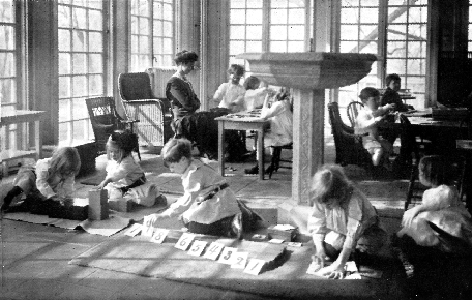
| Montessori Schooling |
In an article entitled”
PARENT INVOLVEMENT IN SCHOOLS PRESSED”, Priscilla
Van Tassel suggests that parents’ role in education needs to ultimately be
scrutinized, for the children’s concern. There is an overall effort taking
place to instill common communication and participation among parents and
students in education. The article focuses on fostering parental involvement by
initially providing them with resources and different ways of going about it.
Some examples include simply taking out sometime during that day to talk with
children regarding daily events, daily checking their homework, etc. These
aspects should essentially benefit the children as parents become closer, and
more involved.
 |
| PARENTS GUIDE CHILDREN |
Ultimately, education is a process and parental involvement will positively
influence children’s studies, as well as their complete educational experience.
The goal is to encourage parents to partake in their children’s lives in
general, which will translate into their education. There is also a
parent-teacher involvement campaign which incorporates parents and teachers
communicating with each other regarding the student. The article states,’
Research shows a clear correlation between parents' help at home and student
achievement.'' Additionally, parents basically have first-hand knowledge of
their children and their personalities, and with that they may discuss what can
be done with a teacher in the school to enhance the child’s education and
success.
In another article, “
School to Parents: Volunteer, or Else!”
Katharine Mieszkowski suggests parents need to volunteer actively, specifically
in their children’s schools, and their reward would be a check, depending on
the amount of hours they put in. It seems as a small bribe for the parents;
however it is beneficial for the student’s sake. This active and direct
approach instills a positive idea to children. They see their parents are
involved with their schooling, and would feel empowered to try their best to
succeed. This is a great motivator as well. The article quotes, “...to engage
them with their children’s learning, even providing parents with academic
training in core math and reading strategies.” As it seems, parents are to be
given some homework for themselves, in terms of contributing themselves
wholeheartedly to their children’s education. Their involvement would include
actual learning of the children’s topics, which is as specific as it gets. The
article essentially digresses to ensure the fact that it is a volunteer
position, which is optional; as parents may have multiple jobs, not all parents
could physically involve themselves for however many hours intended. Though,
they have the choice and will be given brochures to find out about all the
information. Both articles push for parental involvement in schools for the
benefit of the students succeeding and growing up into motivated adults that
share their parents respect.

Parental involvement is virtually evoked from the parents’ overalls sense of
commitment; it is combined with their active participation and utmost devotion
to bettering their children’s lives. Parental involvement is more than just
checking children’s’ hw. It is a lifestyle that parents and children should essentially
adjust to. It builds communication, bonds, friendship, and trust. All of these
characteristics enhance better child-parent relationships for the future.
Communication is the first step. Schools are the facilitators for
children’s studies. The principals may be the mediators in aiding with the
guidance. In an article, Duncan writes, “Principals are key contributors to
helping parents and other educators understand each other” (Duncan, 1992, p.
13). This harmonious situation should accommodate both parents and teachers so
they may efficiently work together and find ways to help their children
succeed. In a research regarding parental involvement, Loucks writes, “Research
shows that parent involvement in the school results in improved student
achievement” (Loucks, 1992, p. 19). The previous evidence illustrates a
positive correlation between parental involvement in schools and students
achievement and educational success.

When parents get the chance to be fully involved with their
children’s educational endeavors, they promote a feeling of control over their
lives. This creates boundaries for parents to go beyond, and internally and
externally motivate their children to work hard and succeed. Parents need to
create goals, and follow through on them. Overall, the prospect is geared
towards early involvement. This sets a foundation in elementary schools, where
children will easily grasp the various concepts of how to pursue their
lifestyles.
Parents first need to be aware of the situation of being involved.
Then, they have to take direct action and make decisions on improving their
children’s’ lifestyles at home first. They should create a home environment
that encourages learning, communicate on certain expectations for the
children’s achievements, and become involved with the child’s education at
school as well as in the community. While these steps give the impression of
evoking tedious relinquishes, they all translate to positive and comforting
results for the children and the parents. Ultimately, parental involvement
early in the educational process results in more powerful effects.

As stated before, parents need to start early, take initiative, and get
involved. Speak with your children, interact with them, discuss idea with the
principals and teachers at school, encourage intellectual growth, give them
support, and love your children. Teachers should contribute as well, discussing
issues with parents on how to better the situation, and be open minded on
accepting different forms of educating the child. The principal will have the
role as a mediator, working with the parent and teachers to try and resolve any
conflicts, misunderstandings, miscommunication, etc. Last but not least, the
child will have the role of listening, processing, communicating, and trying
his or her best to talk openly and honestly with the parent/teacher/principle.
With an open communicating vessel, many things can be accomplished. The schools
may have PTA meetings more often, schedule school bake sales for parent-teacher
interactions weekly, and have parent-teacher conferences every month as opposed
to every 3-5 months. This will greatly benefit the children involved and will
encourage intellectual growth and educational achievement. This way of showing
love is unconventional and truly fulfilling. It is active, direct, instilling,
and effective. Children will learn from their parents/teacher/principals and
vice verse. Thus, parental involvement is an immeasurable act that will create
positive results and promote children’s overall success.